Blog
-

Let’s Hear it from the Boys about Darius Daniels: Game On!
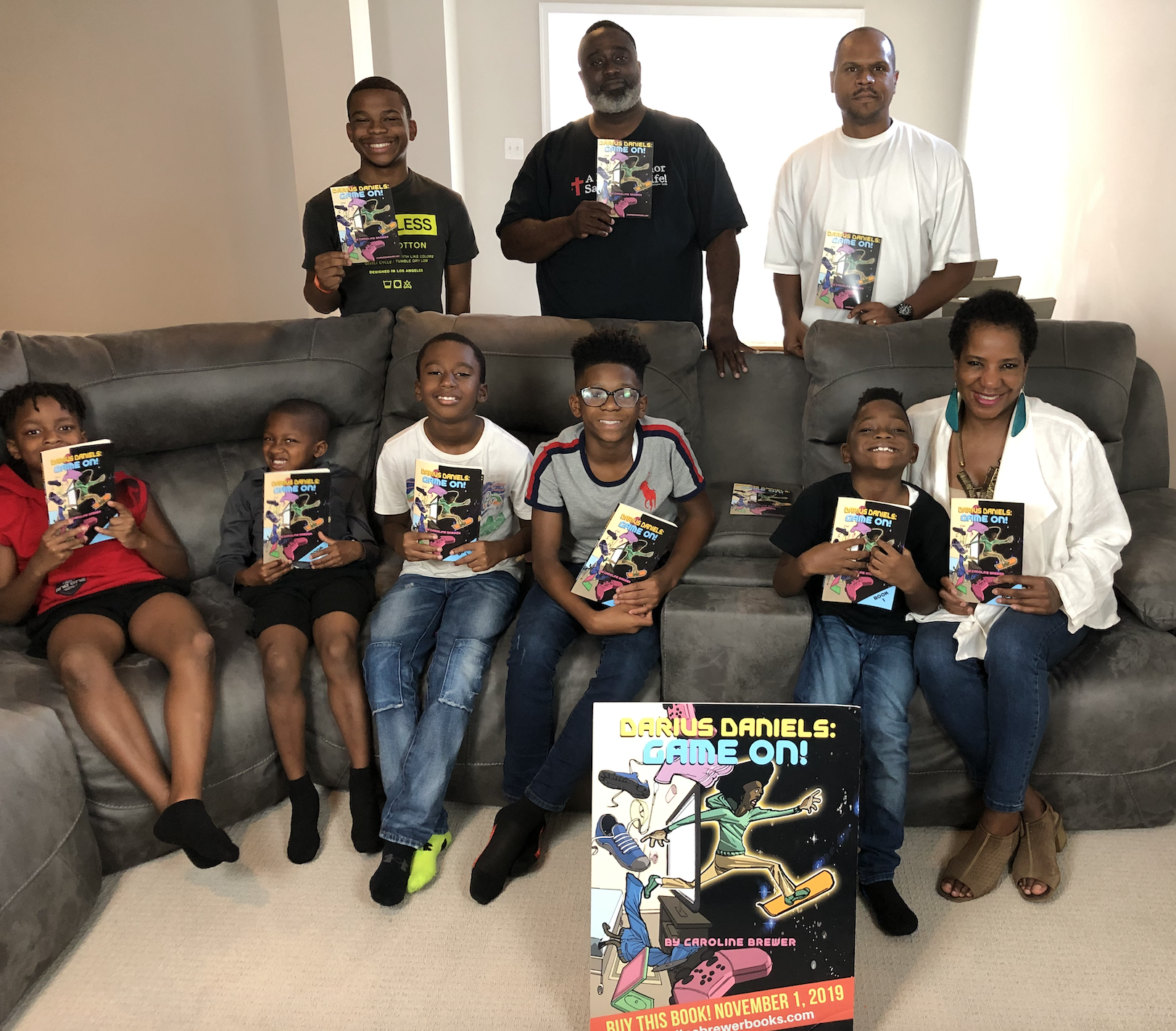
I walked into a room of five boys and five men yesterday afternoon, more than exhausted from two weeks of working around the clock to finish edits to my new children’s novel, Darius Daniels: Game On! I had been excitedly anticipating this day, though, for six weeks. And now it had arrived.The boys were watching television and playing on their phones and I was about to interrupt with conversations about books and literacy. For a moment, it gave me pause. They had never met me, hadn’t heard of me until maybe a week prior, and weren’t sure what to expect. I knew next to nothing of them, either, except that they were members of a new mentoring program offered by Faith Focused Ministries, headed by a dear family friend, Minister Curtis Head. They were from ages 6 to 13 and live in suburban Maryland.I began by asking them questions about the book, based on the poster. Then about reading, based on a my poem Why I Read, and then we read several pages of Darius Daniels: Game On!Here’s what they had to say:“It was a really smart book and you wrote all the pages by yourself and it was really impressive!” – Marco, 2nd grader“I think the book was very detailed and creative.” – Olamide, 3rd grade“This book is good so far because of the rhythm.” – Bryce, 7th grader, who also was inspired to write a poem after reciting Why I Read with the other boys and me.“I don’t usually read books without pictures. But I wanna read this book! I think it’s gonna be very good.” – Zion, 1st grader, who confidently read a page of the 4th grade level book out loud.“The book was really good and entertaining and I loved it!” -John, 8th grader, who said earlier in the day that he didn’t really like to read.These young men are the reason this book and the Hungry Readers campaign exist. They are proof that there’s no reason we should continue to allow 30 million children in America each year to read below grade level. Our children are hungry to read, to write, to learn, to live vibrantly and abundantly. All they need is for us to bring experiences to them, fearlessly, with love and devotion.
PLEASE go to www.carolinebrewerbooks.com to register for the campaign, be first to receive chances to win books, hear new music from the book’s soundtrack, and learn about other exciting opportunities! And please set your calendars for November 1, 2019 to buy copies of Darius Daniels: Game On! for yourself and others, like these brilliant young men! My deepest thanks to Minister Curtis and his team for the commitment they’ve made to these wonderful young men and to all of you!
-

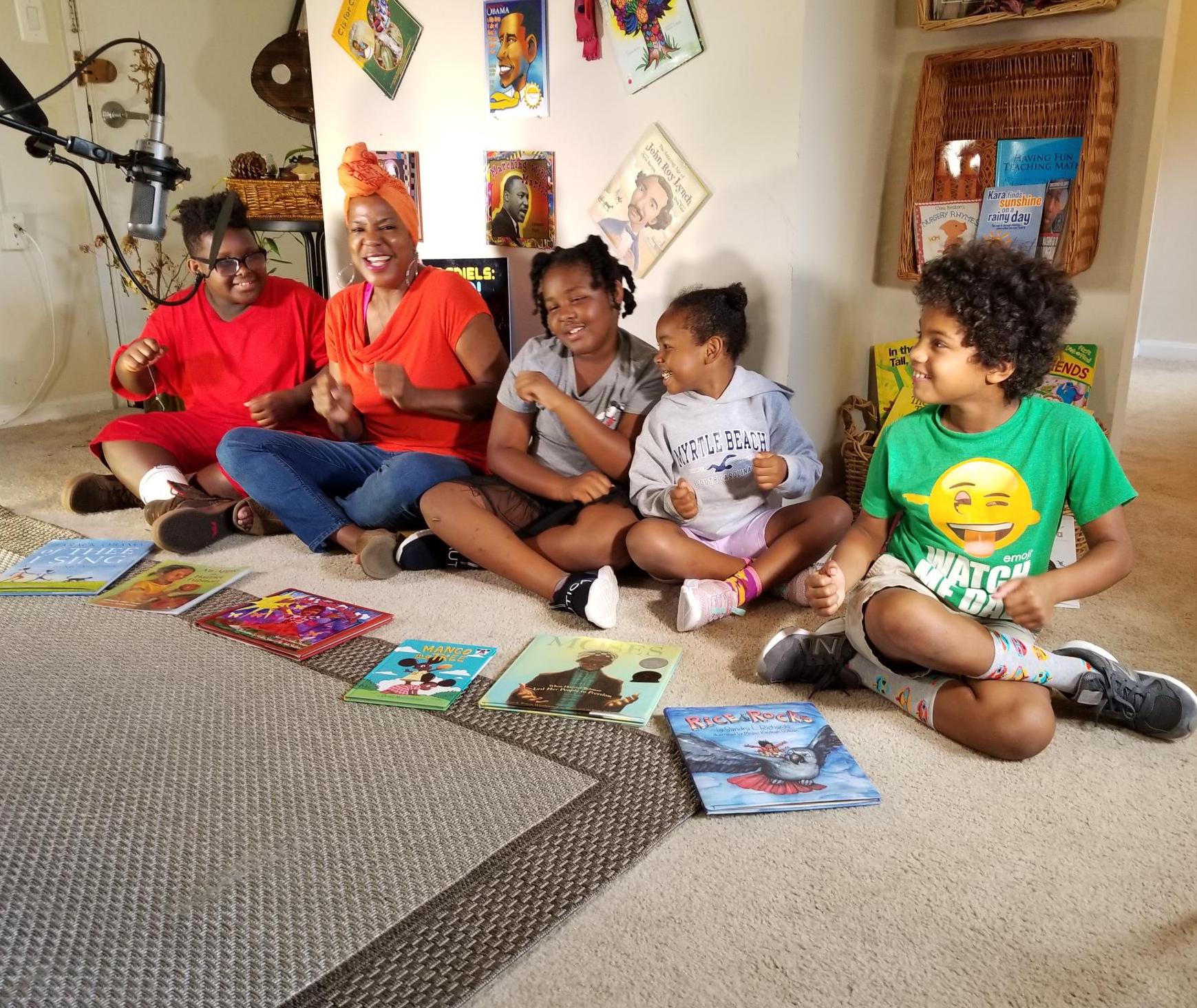
Caroline and Four Amazing Children Celebrate International Literacy Day, Poem-Style
In celebration of #InternationalLiteracyDay 2019, I’m encouraging all adults to make a commitment to spend time feeding the hungry readers and writers in your life with your time and words – words from books, rhyming books, poetry books, comic books, magazines, newspapers, street signs, buildings, letters, cards, and words from their own mouths! Check out our new video reciting my poem, Why I Read, and use it to ignite a discussion about why reading is a good and useful thing, a discussion I’m betting will help them tap into their own power to excel as readers and writers. And, please, let us know how you like the video and how your new reading and writing experiences go.
Click here to read entire poem.WHY I READ POEM BY CAROLINE BREWER 090819
-

Langston Hughes and Kara Finds Sunshine On a Rainy Day
Pssst. Can I tell you a secret? I have something in common with Langston Hughes, poet of world famous works, such as The Weary Blues. Langston, you see, got his start with children’s stories. But he never had a children’s book published. Not until 1994, when children’s book lovers got their wish. The Sweet and Sour Animal Book by Hughes was put out by Oxford University Press. And as its title signals, it’s bursting with playfulness.
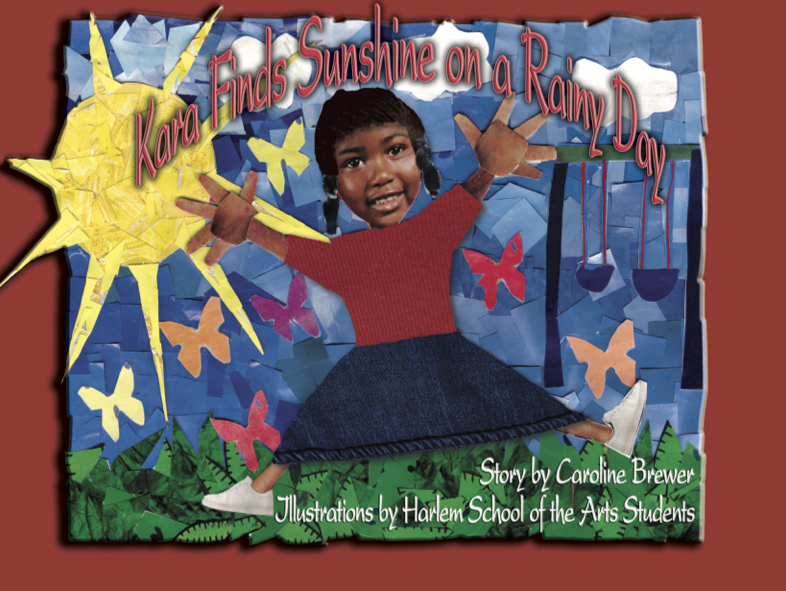
So, what’s the juicy hook between Langston and one of my books? Students from the Harlem School of the Arts will forever be in my heart. First-graders from that lovely school illustrated Hughes’ Sweet and Sour tale. And 11 years later, another group from HSA helped my fifth edition sail …into history with their touching art. A 6th printing is now out of Kara Finds Sunshine on a Rainy Day, and the new edition looks and feels really good, if I must say.
Like Hughes’ book, it tells a story in rhyme, with smile-sparking surprises sprinkled in from time to time.
Kara Find Sunshine on a Rainy Day, just like Sweet and Sour, is chockfull of educational nuggets as captivating as garden flowers.
You can now find the updated book in paperback, wherever books are borrowed or sold. Readers tell me this story of history, hope, and healing is worth its weight in gold. Looking forward to the day when I learn what you have to say about the new and improved Kara Finds Sunshine on a Rainy Day.
Thank you for your support.
-

Reading, Writing: What’s love got to do with it?
More than 15 years ago, I set out on a journey of self-love, to do whatever I wanted with my life, on my own terms. I fell into the lovely craft of writing children’s books, for love. Which led me into schools, religious institutions, day care centers, group homes, and recreational centers to speak on the power of the love of reading and writing, and soon to demonstrate to teachers how to teach literacy effectively, with love. I didn’t understand at that point that it was love guiding my efforts. Wasn’t aware I had stumbled onto a pedagogy of love. (I soon found others acquainted with the practice.)
With teachers, I bore witness to the power of love to ease children’s fears, calm their anxieties, dissolve violent and self-destructive impulses, move them to trust, open up their minds to learning, and their hearts to simple kindnesses. I worked with children one-on-one who were as many as seven grade levels behind in reading and writing. With love (patience, openness, understanding, hopefulness, encouragement, forgiveness, trust, strength, tenderness) as my guide, I saw boys, who were so angry (because of a lack of love) that all they did was curse everybody in sight, transform into the most cooperative and motivated spirits in the classroom. I saw girls who were so afraid of failure that they would refuse to try to read or write begin just weeks later to joyfully read and write in front of their classmates and identify as capable readers and writers. I witnessed children who barely could read and often frustrated their teachers and classmates with distractions become the best readers in their classrooms.
I blame love for it all.
Love is like the seed that is in itself. Love multiplies, elevates, and corrects errors, especially the erroneous thinking that those who are deficient in love have about themselves.
Where there is love, there is no fear. Not of family or friends, co-workers, situations, circumstances, places, or things. If we’re not loving, we’re not living. Let us begin with self and stretch out our hands in love to others through high-minded deeds, unselfish pursuits, and goals. And watch love pay us back with riches in peace, harmony, and happiness that no amount of skill in politics or technology, no amount of money or connections, and no quantity of strong drink or gratuitous activity could hope to match.
Let us ask ourselves: Who and what can we love more today? -

10 ways to successfully engage boys in school
We have a tragedy in America when it comes to connecting with and educating boys.
According to the book Reaching Boys, Teaching Boys: Strategies That Work and Why, boys are kept back in schools at twice the rate of girls. Boys get expelled from preschool nearly five times more often than girls. Boys are diagnosed with learning disorders and attention problems at nearly four times the rate of girls, Jessica Lahey wrote some years ago for The Atlantic. It still holds true today.
Lahey shared eight key approaches to classroom instruction that can lay the foundation for brighter futures for our boys. I added two others that address how we talk to boys. So, 10 ways to engage boys for successful academic outcomes are:
- Lessons that result in an end product–a booklet, a catapult, a poem, or a comic strip, for example.
- Lessons that are structured as competitive games.
- Lessons requiring motor activity.
- Lessons requiring boys to assume responsibility for the learning of others.
- Lessons that require boys to address open questions or unsolved problems.
- Lessons that require a combination of competition and teamwork.
- Lessons that focus on independent, personal discovery and realization.
- Lessons that introduce drama in the form of novelty or surprise.
- Use Language that shows empathy.
- Use Language that uplifts, inspires and encourages freedom of choice.
Without knowing it or planning it, my first interactions with students just so happened to be what boys needed. My goal was to make workshops, read-alouds, and classroom literacy instruction as exciting as possible. I wasn’t thinking about reaching boys. I was thinking about reaching children — and not getting booed off the stage — which essentially happened with a group of high school boys when I was an editorial writer. I had been invited to give a talk and mistakenly was scheduled to arrive in the middle of their recreational time. Worse, I began my “motivational” talk by spraying them with stats about all the calamities that would befall them if they didn’t take it upon themselves to get an education.
How dense of me. They rebelled at what felt like a damning sermon, and, right at that moment, I understood they were doing the right thing.
I practically owe those boys — from so-called “low-income, single-parent families” and “high-crime neighborhoods” — my career. They taught me always to speak to children with empathy and encouragement, and make it clear that I have the highest expectations for them.
I encourage you to give just one of these approaches a try and let us know how it goes.