Media Opportunities December 6 & 7
Immediate Release – December 5, 2022
Contact Caroline Brewer, caroline@carolinebrewerbooks.com for more information
Washington, D.C. – When Children’s Book Author Caroline Brewer speaks to children about her new picture book, Say Their Names, she brings priceless gifts. Some are on the backs of a bookmark, or a special card, inside a gift bag printed on paper, or made of sparkly icing emblazoned on a sugar cookie. The gifts are words, such as hope, courage, peace, love, and light – representing some of the 30+ “gifts” readers can find inside the story of Say Their Names. The new picture book by Reycraft Books features the fictional 7-year-old Aliya on her quest to lead a love-inspired Black lives movement. Aliya’s gifts, Brewer says, are the elements of a positive identity, which researchers say can lead to smoother transition to adulthood. “A positive identity is what Say Their Names is all about, and it’s a gift that couldn’t be more appropriate given the challenges our children face today,” she added.
Children, parents, and educators agree.
“And what I really like about it is how you put a little kid on there and you made (Aliya) strong and brave and independent to do what she got to do and she’s wonderful,” Andreya, a 5th grader at Simon Elementary in D.C., wrote after Brewer’s author visit in November.
” Teaching the value and dignity of all is at the heart of our school’s mission and this book says to our scholars that their lives matter and that they, even in their youth, are powerful and can transform the world,” said Nicole Peltier Lewis M.Ed, Principal of Annunciation.
Brewer, a DC resident and literacy consultant, will visit two schools this week to offer gifts that children can make their own:
9:30 – 10:30 a.m. – Tuesday, December 6, 2022 – Annunciation Catholic School, 3810 Massachusetts Ave. NW, Washington D.C. 20016
1:00 – 1:45 p.m. – Wednesday, December 7, 2022 – Truesdell Elementary, 800 Ingraham St. NW Washington, D.C. 20011 (Pen-Faulkner Author Visit)
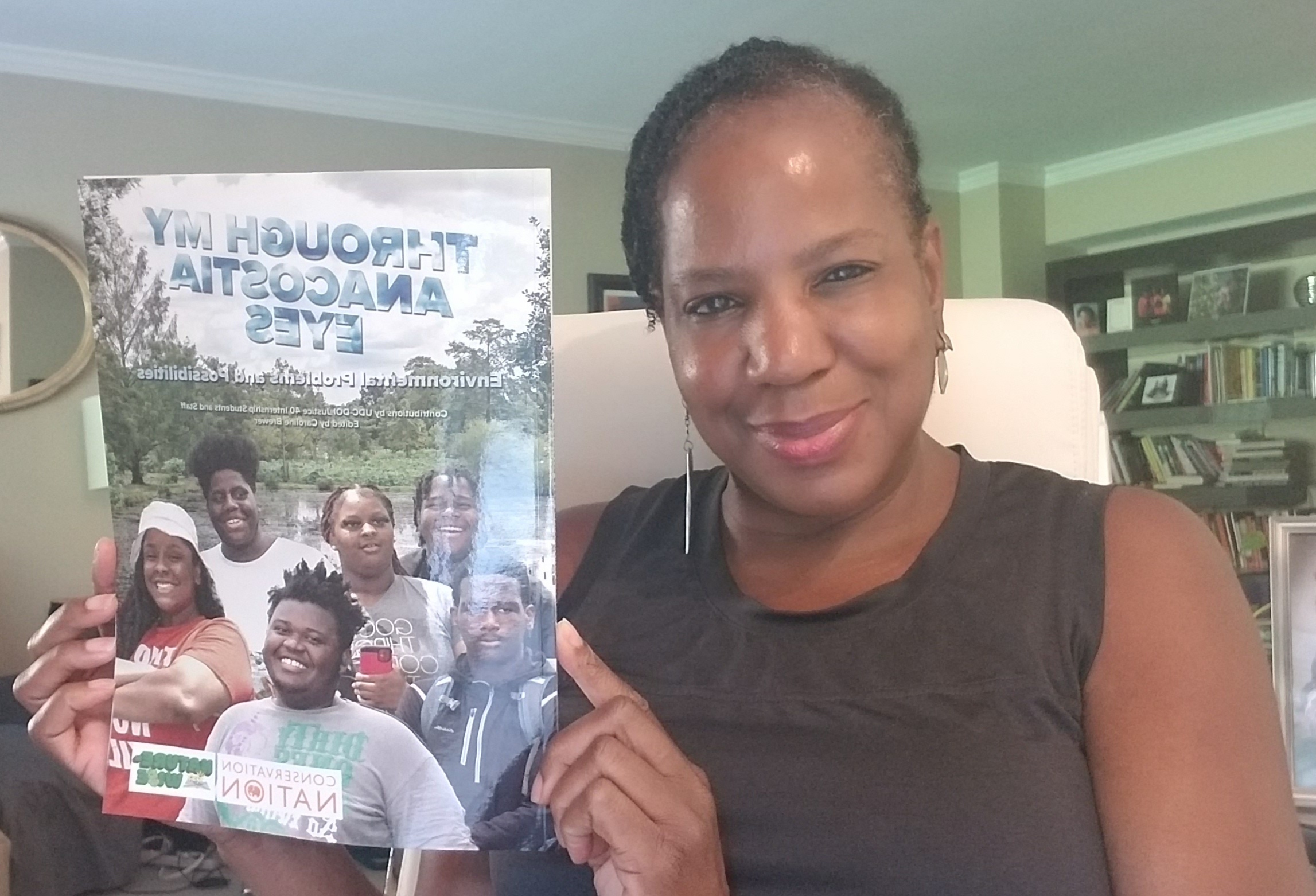

About what the Anacostia High School students saw
with their own eyes,
and filtered through their lived experiences.
This book is about voice.
About what came from the students’ mouths
–rhythmically, poetically, chronologically, with vulnerability —
about what they observed, reflected on,
and processed alone and in community with one another.
And in the seeing and speaking,
they have given us a book to cherish
— a book of poems, essays, reports, and images
that reveals what they felt, emotionally,
what they touched physically,
what they tasted, and what they heard.
And we owe them our deepest appreciation,
because what they have given us is profound!
The book is about journeys,
each of us separately, and all of us together
liberating ourselves, flying, like the birds, free,
dismantling the shackles of fear,
overcoming our insecurities,
touching truth and becoming one with it.
This book is about partnerships.
Many thanks to Conservation Nation
for sponsoring my Nature-Wise program with
the students, to Xavier Brown for
inviting me in to host the literacy
and the environment training,
to Patrick Gusman, UDC, the
Department of the Interior and
NPS for leading the establishment
of this summer internship program
and enthusiastically supporting our efforts
to engage the students as thinkers, readers, writers,
and critical observers of their relationship to nature
and in how to become even better advocates
for sustainability.